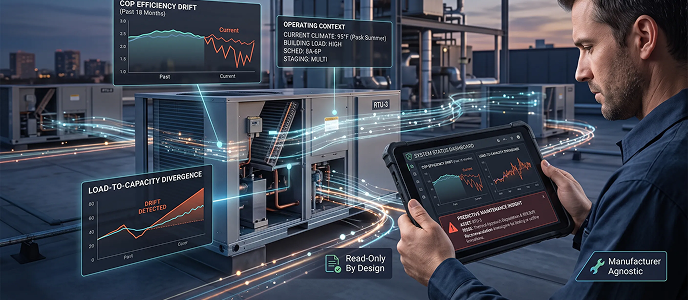
See the Drift Before the Disruption
HVAC systems rarely move from “healthy” to “failed” in a single moment.
Performance often changes gradually. Efficiency can decline. Capacity response can shift. Temperature relationships can move away from established behavior. Runtime can increase under comparable conditions. A system may continue to operate while quietly consuming more energy, delivering less capacity, or moving toward a larger maintenance concern.
The challenge is that these changes are not always obvious during routine operation.
TrueClime helps bring them into view.
By evaluating real-world HVAC performance over time, TrueClime helps owners and operators identify emerging drift, abnormal operating patterns, and changes in system behavior that may warrant investigation.
The goal is not to claim that every failure can be predicted.
The goal is to provide earlier, more meaningful insight into how a system is changing.
Maintenance Often Begins After the Problem Becomes Visible
Traditional maintenance programs remain essential. Inspections, service intervals, alarms, technician expertise, and preventive maintenance all play important roles in keeping HVAC systems operating.
But many developing performance issues can exist before a conventional alarm is triggered or an obvious failure occurs.
A unit may still run.
A space may still reach setpoint.
A compressor may still stage.
A pump may still circulate water.
Yet the system may no longer be performing the way it once did under comparable conditions.
That distinction matters.
A system that is technically “running” is not necessarily a system that is performing well.
TrueClime focuses on the operating behavior behind that distinction.
From Static Snapshots to Performance Over Time
A single measurement can be useful, but HVAC performance is highly dependent on context.
Outdoor conditions change.
Building loads change.
Occupancy changes.
Schedules change.
Equipment stages differently.
Control sequences respond differently.
A meaningful assessment must therefore ask more than:
“What is the value right now?”
It should also ask:
“How is this system behaving compared with its own established performance under relevant conditions?”
That is where predictive maintenance insight becomes valuable.
TrueClime evaluates available operating data over time to help identify changes that may otherwise remain hidden inside normal day-to-day variation.
EER / COP Performance Drift
Efficiency is not a fixed number in a real building.
It changes with load, climate, operating mode, equipment staging, and system conditions. But when performance is evaluated in context, persistent changes in EER, COP, or equivalent efficiency relationships can reveal meaningful degradation.
For example, a system may begin requiring more input energy to deliver comparable cooling or heating performance.
That does not automatically identify a specific fault.
But it can provide an important signal:
Something about the system’s operating behavior has changed.
TrueClime helps surface those changes so teams can investigate them with greater context.
Potential contributors may include:
- Heat-transfer degradation
- Refrigerant-side issues
- Airflow changes
- Water-flow changes
- Control behavior
- Compressor or staging changes
- Sensor issues
- Changing system interactions
The purpose is not to jump immediately to a diagnosis.
The purpose is to recognize when performance is moving away from established behavior.
Load-to-Capacity Divergence
A healthy HVAC system should respond to load in a way that is reasonably consistent with its operating conditions and configuration.
Over time, that relationship can change.
The building may require more runtime to satisfy a similar load.
Delivered capacity may no longer track changing demand as expected.
Equipment may stage differently.
Recovery behavior may slow.
A system may remain operational while the relationship between load and delivered performance begins to diverge.
TrueClime helps evaluate these relationships over time.
Emerging mismatch may point toward:
- Declining capacity
- Control inefficiency
- Staging issues
- Changing airflow or water flow
- Equipment degradation
- Changing building conditions
- System interaction effects
Again, the insight is not:
“A failure is guaranteed.”
The insight is:
“The system is no longer responding the way it previously did under comparable conditions.”
That can be a valuable starting point for maintenance prioritization.
Thermal Approach Degradation
Temperature relationships are fundamental to HVAC performance.
Across coils, heat exchangers, hydronic loops, refrigerant circuits, and system stages, changes in thermal relationships can reveal declining effectiveness.
An increasing approach temperature, reduced heat-transfer effectiveness, or persistent deviation from established temperature behavior may indicate that performance is changing.
Depending on the system, possible contributors may include:
- Fouling
- Airflow limitations
- Water-flow changes
- Heat-exchanger degradation
- Coil performance changes
- Refrigerant-side conditions
- Control issues
- Sensor drift
TrueClime evaluates these changes in the context of actual system operation.
The objective is to move beyond isolated temperature readings and understand whether thermal behavior is changing over time.
Operating Context Matters
One of the greatest challenges in HVAC analytics is separating real performance change from normal operational variation.
A unit operating on a mild day should not necessarily be compared directly with the same unit operating during peak summer conditions.
A lightly occupied building should not be treated the same as a fully loaded building.
A system running under one schedule, sequence, or staging condition may behave differently under another.
That is why TrueClime emphasizes operating context.
We evaluate performance in relation to factors such as:
- Actual climate
- Building load
- Occupancy patterns
- Schedules
- Equipment staging
- Operating modes
- System configuration
- Historical behavior
This helps distinguish normal variation from changes that may deserve closer attention.
Predictive Maintenance Insight Is Not the Same as Predicting Every Failure
The phrase “predictive maintenance” is often used too broadly.
No responsible analytics platform should imply that every mechanical failure can be forecast perfectly.
Some failures are sudden.
Some are driven by conditions that may not be visible in the available data.
Some require specialized instrumentation or direct physical inspection.
TrueClime takes a more practical approach.
We focus on identifying performance drift and abnormal operating behavior that may provide earlier visibility into emerging concerns.
That insight can help teams:
- Investigate sooner
- Prioritize maintenance attention
- Reduce unnecessary guesswork
- Compare assets more intelligently
- Support service conversations with better context
- Recognize degradation before it becomes more severe
Predictive maintenance insight should strengthen human decision-making, not replace it.
Read-Only by Design
TrueClime is strictly read-only.
We do not write commands to HVAC systems.
We do not change setpoints.
We do not override sequences.
We do not control equipment.
Our role is to observe, evaluate, and provide context.
That distinction matters because maintenance insight should not require introducing additional control risk into the building.
TrueClime is designed to help owners and operators understand what their systems are doing while leaving operational authority where it belongs.
Independent by Design
TrueClime is not affiliated with an HVAC manufacturer.
We do not sell equipment.
We do not have an incentive to steer analysis toward a particular OEM, replacement product, or controls platform.
Our objective is to help the building owner and operator better understand actual system performance.
That independence is especially important when maintenance decisions can affect:
- Operating costs
- Capital budgets
- Equipment life
- Energy use
- Comfort
- Sustainability goals
The data should serve the owner.
From Reactive Maintenance to Informed Intervention
Reactive maintenance asks:
“What failed?”
Predictive maintenance insight asks:
“What is changing?”
That difference can be significant.
When owners and operators can see emerging efficiency drift, changing capacity response, altered thermal behavior, and abnormal operating patterns earlier, they can make better-informed decisions about where to investigate and when to act.
Not every drift becomes a failure.
Not every anomaly requires intervention.
But greater visibility creates the opportunity for better judgment.
And in complex HVAC systems, that can make the difference between reacting to a disruption and understanding the warning signs that came before it.
See the Drift Before the Disruption
Every building is different.
Every system operates under its own climate, loads, schedules, configuration, and history.
TrueClime helps evaluate HVAC performance in that real-world context.
Independent.
Manufacturer-agnostic.
Strictly read-only.
Focused on the systems you actually own and operate.
Because better maintenance decisions begin with knowing how performance is changing.
Start the Conversation
Learn how TrueClime can help bring greater visibility to HVAC performance drift and emerging operational concerns across your building or portfolio.