Energy and sustainability goals are increasingly central to building operations, capital planning, and long-term asset strategy. But meaningful progress requires more than targets, benchmarks, and annual utility totals.
It requires clarity.
For many commercial buildings, HVAC represents one of the most consequential areas of energy use, operational complexity, maintenance exposure, and capital investment. Yet decisions about HVAC performance are often made using incomplete information: utility bills, standardized equipment ratings, isolated maintenance observations, or assumptions about how systems should be operating.
TrueClime believes a better starting point is understanding how systems are actually performing.
Standardized Ratings Matter — But Buildings Operate in the Real World
Standardized equipment ratings provide essential reference points. They create consistency and allow equipment to be evaluated under defined conditions.
But an installed HVAC system does not operate under one fixed climate, one constant load, one schedule, or one sequence.
Real buildings experience:
- changing outdoor temperature and humidity
- variable occupancy
- shifting internal loads
- changing operating schedules
- part-load conditions
- equipment staging
- control interactions
- aging equipment
- maintenance effects
- building-specific operating constraints
That means the sustainability question is not only:
How efficient was this equipment rated to be?
It is also:
How is this installed system performing here, now, under the conditions it actually experiences?
That distinction matters.
Energy Performance Needs Context
A change in energy use does not automatically tell you why performance changed.
Higher consumption may reflect:
- more severe weather
- greater occupancy
- increased process loads
- longer operating hours
- declining equipment efficiency
- changing control behavior
- capacity mismatch
- simultaneous heating and cooling
- degraded heat transfer
- abnormal staging
- other operational changes
Without context, energy data can lead to the wrong conclusion.
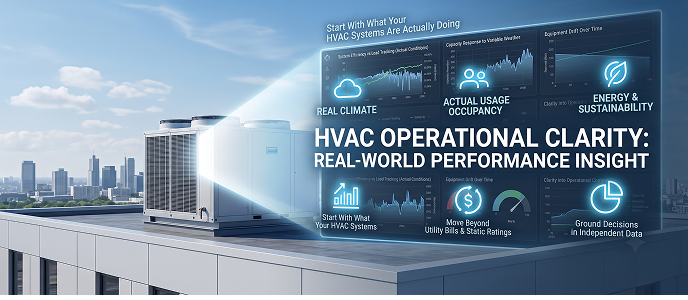
TrueClime evaluates available HVAC operating data in relation to real climate, real loads, and actual system behavior. The goal is to help distinguish changing conditions from changing performance.
That context can support better decisions.
From Energy Consumption to Performance Insight
Utility data is important, but total consumption alone cannot fully explain how individual HVAC systems are performing.
A building may consume more energy because loads increased. Another may consume the same amount of energy while delivering less useful heating or cooling. A third may show little change in annual consumption while an individual system experiences meaningful efficiency drift.
Real-world performance analysis can help surface questions such as:
- Is efficiency changing under comparable operating conditions?
- Is system capacity response tracking load as expected?
- Are thermal relationships shifting over time?
- Is performance degrading gradually?
- Are certain assets contributing disproportionately to energy demand?
- Are operational patterns changing in ways that warrant investigation?
These questions move the conversation beyond simple consumption and toward performance understanding.
Sustainability Decisions Should Be Grounded in Actual Operations
Sustainability strategies often involve major decisions:
- retrofit or replace?
- repair or continue operating?
- electrify now or later?
- prioritize one building over another?
- invest in controls?
- replace aging equipment?
- pursue heat-pump conversions?
- modify operating strategies?
- allocate limited capital across a portfolio?
These decisions can have long-term financial and environmental consequences.
TrueClime’s position is simple:
The more consequential the decision, the more important it is to understand where the system actually stands today.
Real operating data can help provide that foundation.
Better Insight Can Support Better Capital Allocation
Not every inefficient-looking system needs immediate replacement.
Not every older system is necessarily the first asset that should receive capital.
And not every retrofit opportunity creates equal value.
By evaluating actual performance behavior, owners and operators can gain additional context for questions such as:
- Which assets show the greatest performance drift?
- Which systems operate reasonably well despite age?
- Where might maintenance investigation be justified before replacement?
- Which retrofit opportunities deserve deeper analysis?
- Where could capital have the greatest operational or sustainability impact?
This does not eliminate engineering judgment. It strengthens it with better operational evidence.
Sustainability Is Also About Avoiding Unnecessary Decisions
Sustainability discussions often focus on what should be added, replaced, or upgraded.
But there is another side to the equation: avoiding unnecessary intervention.
Replacing equipment prematurely can carry significant embodied carbon, capital cost, material use, and operational disruption. Continuing to operate genuinely degraded equipment can also create avoidable energy and environmental impacts.
The challenge is knowing the difference.
Better performance visibility can help owners make more informed choices about when to:
- maintain
- investigate
- optimize
- retrofit
- replace
- continue operating
That is an important part of responsible asset stewardship.
Independent Insight Matters
TrueClime is manufacturer-agnostic by design.
We do not sell HVAC equipment. We are not affiliated with an OEM. We do not have an equipment-sales incentive influencing the analysis.
Our focus is the performance of the systems already installed in your building.
That independence matters when energy, sustainability, and capital decisions intersect.
Strictly Read-Only
TrueClime is also strictly read-only.
We do not write commands to HVAC systems, alter sequences, override controls, or operate equipment.
Our role is to evaluate available operating data and provide independent performance context while preserving the separation between analysis and control.
We Cannot Reach the Future Without Understanding the Present
Net-zero goals, decarbonization strategies, electrification plans, and sustainability commitments all depend on decisions made today.
But ambitious targets alone do not tell us how existing systems are actually performing.
Before asking how far a building needs to go, it helps to know where it truly stands.
That is the role of real-world HVAC performance insight.
We are not going to reach Net Zero as a society without knowing where we actually are today.
TrueClime helps bring that clarity into focus.
Your Climate. Your Loads. Your Operating Reality.
Every building is unique.
TrueClime evaluates HVAC performance in the context that matters most: the conditions your systems actually experience.
Independent. Manufacturer-agnostic. Strictly read-only.
Ready to understand what your HVAC systems are actually doing?
Start the conversation with TrueClime.