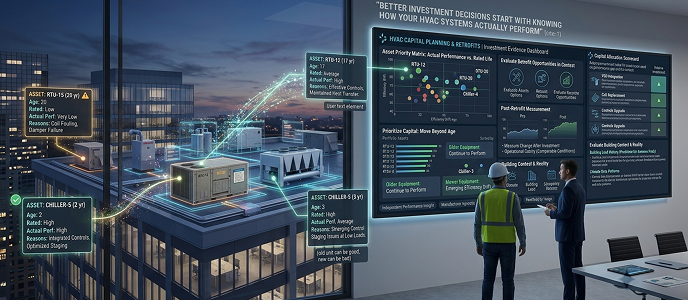
Better Investment Decisions Start with Knowing How Your HVAC Systems Actually Perform
HVAC systems are among the most significant assets in a commercial building. They affect operating costs, occupant comfort, maintenance priorities, energy use, sustainability goals, and long-term capital requirements.
Yet major retrofit and replacement decisions are often made with an incomplete picture.
Equipment age matters. Maintenance history matters. Rated efficiency matters. Utility consumption matters.
But none of these, by themselves, answer the most important question:
How is the installed HVAC system actually performing in this building, under this climate, at these loads, and within these operating conditions?
That is where TrueClime adds context.
Capital Planning Requires More Than Equipment Age
A common approach to HVAC capital planning is to begin with useful but limited indicators such as:
- Equipment age
- Expected useful life
- Maintenance frequency
- Repair history
- Nameplate efficiency
- Manufacturer ratings
- Energy consumption
- Replacement cost
These inputs are important. But a 15-year-old unit is not automatically a poor performer, just as a newer unit is not automatically operating efficiently.
Two apparently identical pieces of equipment can behave very differently because of:
- Climate
- Building loads
- Occupancy
- Schedules
- Control sequences
- Airflow
- Installation conditions
- Maintenance history
- System interactions
- Part-load operation
TrueClime helps bring actual operating performance into the capital-planning conversation.
From Assumptions to Operating Evidence
Standardized equipment ratings provide essential reference points. They help establish comparable performance under defined conditions.
Buildings, however, do not operate at a single rating point.
Real HVAC systems experience changing:
- Outdoor temperatures
- Humidity levels
- Internal loads
- Occupancy patterns
- Operating schedules
- Heating and cooling demands
- Part-load conditions
A retrofit decision should therefore consider not only how equipment was rated, but how the installed system is behaving over time.
TrueClime evaluates available real-world HVAC performance data in the context of actual operating conditions.
The goal is not to replace engineering judgment, standardized ratings, or sound design practice.
The goal is to add another layer of clarity.
Establish the Current Performance Baseline
Before asking whether a system should be replaced, it is useful to understand where it stands today.
A real-world operating baseline can help establish:
- Current efficiency behavior
- Capacity response
- Thermal performance
- Load response
- Runtime patterns
- Operating stability
- Performance drift
- Seasonal behavior
This creates a more informed starting point for capital discussions.
Without a meaningful baseline, it can be difficult to distinguish between:
- Normal performance
- Emerging degradation
- Control-related inefficiency
- Load changes
- Weather effects
- Maintenance issues
- Genuine equipment limitations
Prioritize Capital Where It Matters Most
Most building owners do not have unlimited capital.
The real challenge is often not identifying that HVAC investment is needed. It is deciding:
Where should we invest first?
TrueClime can help support that prioritization by bringing performance context to installed assets.
For example, a portfolio may contain:
- Older equipment that continues to perform well
- Newer equipment showing unexpected efficiency drift
- Systems that appear inefficient only under specific load conditions
- Equipment that struggles during particular climate conditions
- Assets whose operating behavior may warrant further investigation
This can help decision-makers move beyond age-based replacement alone and toward more evidence-informed prioritization.
Evaluate Retrofit Opportunities in Context
A retrofit may involve:
- Equipment replacement
- Heat-pump conversion
- Chiller modernization
- Boiler replacement
- Controls improvements
- Airside upgrades
- Energy recovery
- Variable-speed technology
- Compressor staging changes
- Electrification
- Other system modifications
The value of a retrofit depends heavily on the system it is replacing and the conditions in which the new solution will operate.
A generalized estimate may be useful during early planning.
But the more consequential the investment, the more valuable it becomes to understand actual system behavior before the decision is made.
TrueClime helps support questions such as:
- Where is current performance strongest or weakest?
- Under what conditions does performance change?
- Which assets show the greatest opportunity for improvement?
- Are observed issues persistent or condition-dependent?
- Which systems should be investigated first?
- Where might additional capital produce the most meaningful operational value?
Support More Defensible Business Cases
Capital projects often compete for funding.
Facilities teams may need to communicate with:
- Ownership
- Finance
- Executive leadership
- ESG teams
- Sustainability teams
- Asset managers
- Investors
A stronger business case is easier to build when decisions are grounded in actual operating evidence.
Real-world performance context can help strengthen discussions around:
- Current-state performance
- Operational risk
- Energy use
- Maintenance priorities
- Retrofit timing
- Replacement sequencing
- Sustainability objectives
TrueClime helps make those conversations more informed.
Improve Retrofit Measurement
A useful retrofit question is not only:
What should we replace?
It is also:
What changed after the investment?
Establishing pre-retrofit operating behavior can create a stronger foundation for evaluating post-retrofit performance.
Depending on available data, this may help teams better understand:
- Changes in efficiency
- Changes in load response
- Changes in runtime behavior
- Changes in thermal performance
- Changes under comparable conditions
This provides a more meaningful basis for understanding whether a retrofit delivered the intended operational result.
Independent by Design
TrueClime is not an HVAC manufacturer.
We do not sell equipment.
We are not affiliated with an OEM.
We are strictly read-only.
That independence matters when evaluating capital decisions.
Our role is not to steer a customer toward a particular brand or product. Our role is to help provide clearer performance context around the systems already in operation.
Every Building Is Unique
No two buildings operate exactly the same way.
Different buildings have different:
- Equipment
- Configurations
- Control strategies
- Schedules
- Loads
- Climates
- Occupancy patterns
- Capital priorities
That is why TrueClime focuses on real operating conditions rather than relying only on generalized assumptions.
Your climate. Your loads. Your systems. Your operating reality.
That is the context capital planning deserves.
Make Capital Decisions with Greater Clarity
Before committing to a major HVAC retrofit or replacement program, understand how the installed systems are actually performing.
TrueClime helps building owners, facility managers, portfolio operators, and sustainability teams bring independent, read-only performance insight into capital planning and retrofit decisions.
Start the conversation.